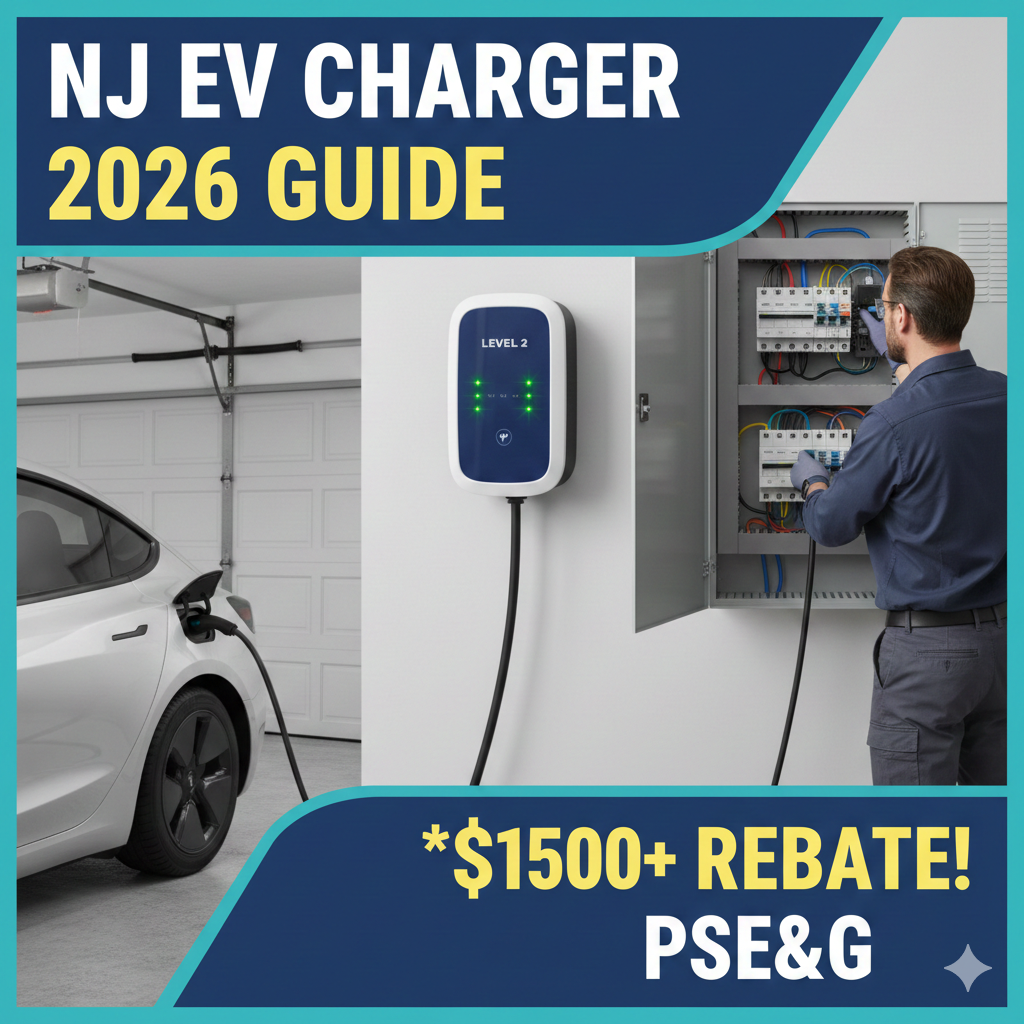
How to Install a Level 2 EV Charger at Home: 2026 Guide for New Jersey Residents (PSE&G Rebates)
So you are thinking about getting a Level 2 EV charger for your home. This is a good idea. It is one of the things you can do in 2026. If you live in New Jersey or a state like that you can get a lot of money back from companies like PSE&G.
They will help pay for a part of your Level 2 EV charger. We will tell you everything you need to know. We will go through the process of installing a Level 2 EV charger and how much it will cost you. We will also show you how to get your rebates, which can be over $1,500, for a Level 2 EV charger.
Step-by-Step Guide to Level 2 EV Charger Installation
Site Assessment
Before buying hardware pick a location. It can be your garage or driveway. Keep in mind: The closer your charger is to the panel the less you will spend on wiring.
- Electrical Panel Inspection
A Level 2 charger needs a 240V circuit. You have to check if your electrical panel has space and power for a new circuit breaker.
- Hire a Certified Licensed Electrician
For PSE&G rebates you need an electrician from New Jersey. They will check if your homes system can handle the vehicles power without any issues.
- Secure Necessary Permits
Do not skip this step. You must get a permit from your local office. Installing without a permit is against the law can result in fines. Might void your home insurance.
- Professional Installation
Your electrician will install a circuit, usually 40A to 50A and mount the charger on your wall. They will ensure all wiring meets the National Electrical Code.
- Final Inspection & Certification
After installation a city inspector must approve the work. Once they approve you will get a certificate making your installation legal and eligible, for utility credits.
Estimated Installation Cost Breakdown (2026)
The cost of things can be different depending on the layout of your home and what people are charging for labor in your area. On average:
- Basic Installation: this can cost you around $800 to $1,500. This is if the panel is really close to the charger.
- Panel Upgrade: if you need to do this it can cost $2,000 to $3,000.
- Permit Fees, for the Panel Upgrade and Basic Installation: you will have to pay $50 to $150 for these.
PSE&G Rebates & Savings: Maximize Your ROI
People who live in New Jersey have a good deal with the PSE&G Residential Charging Program.
They can get some money back.
The Make-Ready Credit gives them, up to $1,500 to help pay for the cost of their wiring and panel upgrades and the labor to do it.
They can also get a Charger Rebate. This means they get a $250 if they put in an ENERGY STAR certified smart charger.
The Off-Peak Credit is another way for them to save money. When they charge their things between 9 PM and 7 AM they can get a credit of 10.5 cents for each kilowatt hour.
A good thing to remember is to keep all the papers that prove they paid for these things. This includes invoices and permit copies and inspection reports. They will need to upload these to the PSE&G portal to get their money.
Top 2026 Tips for EV Owners
- Go Smart: Pick a charger that works with Wi-Fi like ChargePoint or Tesla Wall Connector. This way you can connect with your utility data. Get rewards when its not peak time.
- Federal Tax Credit: See if you can get 30% of the cost back up to $1,000 on your taxes, for the charger and installation. You can claim this on your tax return.
Are all level 2 EV chargers the same?
All level 2 chargers are not the same.
Level 2 chargers can very in the amps for which they are rated. This in turn, impacts the energy the deliver to your EV. More amps=more energy.
They also vary in type. Some are as simple as a glorified extension cord. One end goes into your socket, one end into the car. Others feature control panels, LED screens and wifi or Bluetooth connectivity to you hime network and smartphone. Some require hardwiring directly to your electrical service to deliver maximum output.
Quality of construction varies with price point. Cheaper “generic” variety chargers tend to use lighter gauge wiring, cheaper plugs, and lower grade electronics than higher priced name brand offerings. Many of the generic offerings are not UL listed or certified.
This is not a place to skimp. Your EV is the most expensive, highest draw electric hardware in your home. Buy the charger that meets your charging needs in terms of output but buy quality, UL listed equipment.
I spent a month researching the options before choosing my level 2 charger.
What is a level 2 EV charging station?
Chargers are broken into three levels of speed of charge, but also corresponding to the source of the electricity. Level 1 is from a standard household outlet. In North America it means you can get up to 1.4 kW on 120V. This is some slow charging, taking 10 hours to charge the 40 miles driven each day, on average.
Level 2 is from a higher wattage connection, 240V (or 208V in the US for some 3 phase circuits) at anywhere from 20 amps to 80 amps, with 24 amps being very common. This often provides 5 to 8 kW, enough power to charge the average daily drive in just two hours or less.
Level 3 is the highest level, and covers a lot of ground. It is DC power, which can directly drive the battery without further conversion. At power levels from 50 kW to 300 kW, it provides the fastest charging times, limited mostly by the battery itself.
I actually charge at home on level 1. When I get home from a trip, I seldom go out much for a few days. So I can charge up slowly. I can drive around the local area and not worry about not having enough charge for the next long drive. Charging at 1 kW means I’m not stressing the grid in any way.
Level 2 is much more common for home use. You can use a 240V outlet, or have a charge point unit installed with a direct connection. It typically costs $1,000 to $1,500 installed depending on the wire length needed.
A level 2 EV charging station dilivers an electrical current from an outlet or hardwired unit to the vehicle, similar to a standard issue changer. According to the U.S. Department of Transportation Level 2 equipment offers charging through 240V (in residential applications) or 208V (in commercial applications) electrical services ,and is common for home, workplace, and public charging. Level 2 charges can charge a BEV from empty in 4–10 hr and a PHEV from empty in 1–2 hr.
Frequently Asked Questions (FAQ)
Q: Does PSE&G pay for the charger itself? No. PSE&G pays for the things that need to be done to get your home ready for a charger, like wiring and labor to $1,500. You can also get $250 back if you choose a kind of smart charger.
Q: How long does it take to get the money ? After you send in your papers, like the bill and pictures it usually takes 4 to 8 weeks to get the credit on your utility bill.
Q: Can I install the charger myself? You can try to do it yourself. Pse&g needs a licensed electrician to sign off on it to get the money back for labor. If you do it yourself you might not get that money.
Q: Do I need a meter, for my electric vehicle? No. The charger that you plug your vehicle into can connect right to your homes main electrical panel.
Q: Will it work with a 100-Amp panel? It is hard to say. The charger needs a breaker that can handle 40 or 50 amps. If you have a stove or air conditioner you will probably need to upgrade your panel.
Q: Does the Tesla Wall Connector get a rebate? Yes it does, long as it is the right kind and a professional installs it. The Tesla Wall Connector has to be ENERGY STAR certified to get the rebate. PSE&G will give you money back for the Tesla Wall Connector if it meets these requirements.