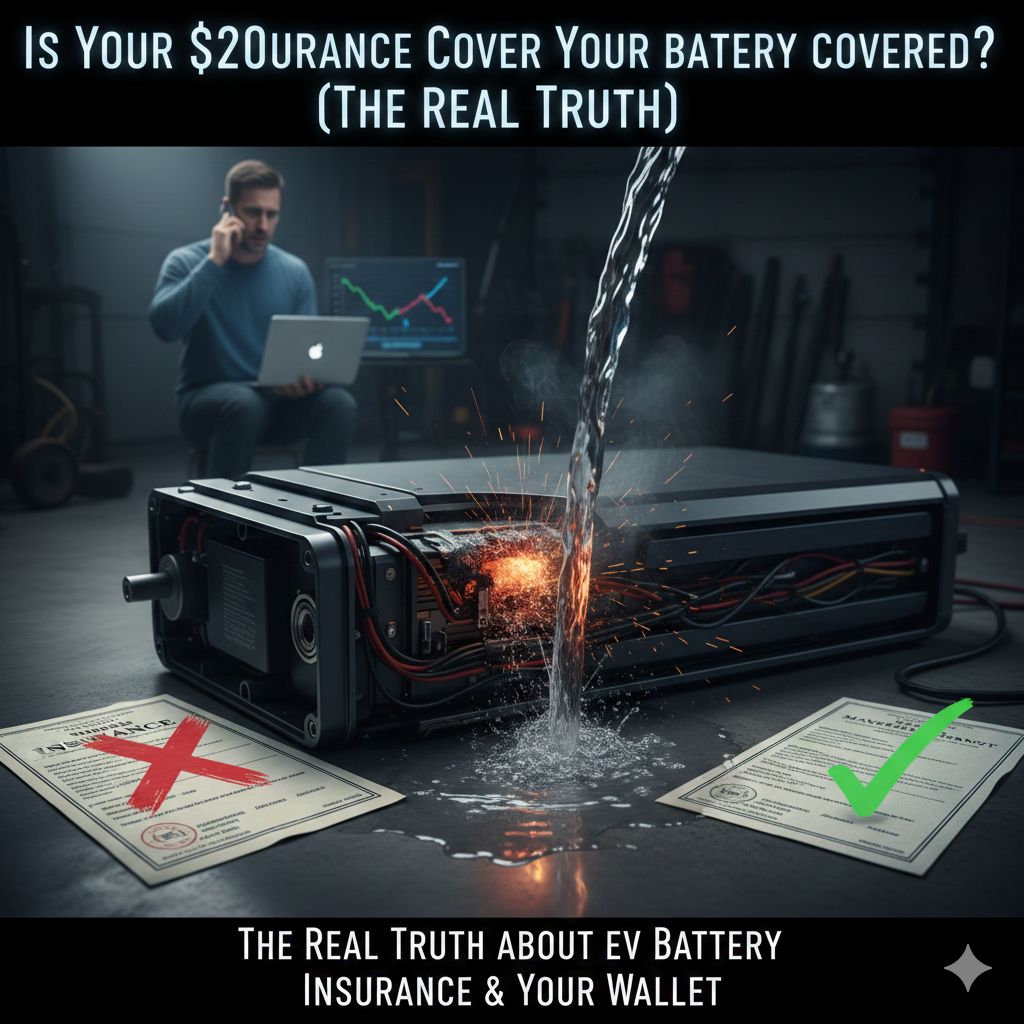
Does Car Insurance Cover Your EV Battery? Here’s the Real Truth
Buying a vehicle is a good idea for your money and the earth.. There is one thing that worries every Tesla or Rivian owner: what if my electric vehicle battery stops working? The cost of replacing an electric vehicle battery can be very high, around $15,000 to $20,000 so you probably want your insurance to pay for it.
You might have heard of Replacement Cost Coverage or Comprehensive Insurance for your vehicle but does it really cover the cost of a dead electric vehicle battery? Let us explain it in terms.
What is Replacement Cost Coverage for EVs?
In the insurance world the things you buy start losing value soon as you drive them off the lot. This is what people call Depreciation.
If you have an insurance policy that pays the Actual Cash Value and something happens to your battery the insurance company will not pay for a brand new one. They will say that your battery is old so it is only worth a percentage of what it was worth when it was new. For example they might say your battery is 4 years old so it is only worth 60 percent of its price. This means you would have to pay the rest, which could be thousands of dollars out of your pocket.
There is something called Replacement Cost Coverage, which some people call New Car Replacement. This is different because the insurance company pays for a brand battery without taking away money because it is old or has been used.. This only works if the reason the battery got damaged is something that the insurance policy covers.
The big question people want to know is: does insurance cover replacing the battery?
The simple answer is: yes. Only if the battery got damaged all of a sudden and, by accident. Insurance is not meant to cover maintenance it is meant to cover unexpected things that happen to your battery.
1. The “Yes” Scenario: Accidental & Environmental Damage
If you have Comprehensive and Collision Coverage you are protected if something bad happens to your car.
Comprehensive and Collision Coverage will help you in these situations:
- Collision: You get into an accident that damages the battery pack of your car.
- Road Debris: Something on the road damages the undercarriage of your car.
- Environmental: A fire in your garage or a flood ruins the battery of your car.
Comprehensive and Collision Coverage is really helpful, in these kinds of situations so you do not have to worry about your car if you have Comprehensive and Collision Coverage.
2. The “No” Scenario: Degradation and Wear-and-Tear
People get confused about the truth. The thing is, insurance does not pay for a battery that just stops working because it is old.
If your electric vehicle used to go 300 miles on a charge. Now it only goes 150 miles after six years that is just what happens when it gets old.
The solution to this problem is that you can count on the Federal Law, which is called the Magnuson-Moss Warranty Act. This law says that electric vehicle batteries have to be covered for least 8 years or 100,000 miles, in the United States.
The Critical Gap: Mechanical Breakdown Insurance (MBI)
Even if you have coverage the insurance company might not pay for problems with the electrical system or software issues in your car. This is why a lot of car owners in the United States think about getting Mechanical Breakdown Insurance or an extended service contract.
Here are some reasons why you might need Mechanical Breakdown Insurance or an extended warranty:
BMS Failure: Mechanical Breakdown Insurance covers the Battery Management System if it breaks after the manufacturers warranty is over. The Battery Management System is a complicated system so it is good to have Mechanical Breakdown Insurance to cover it.
Power Surges: This will help if there is a spike, in electricity when you are charging your car at a public fast charger.
Comparison: Manufacturer Warranty vs. Auto Insurance
| Feature | Manufacturer Warranty | Comprehensive Insurance |
| Accidental Impact | ❌ No | ✅ Yes |
| Old Age (Degradation) | ✅ Yes (Usually <70% SoH) | ❌ No |
| Fire or Flood | ❌ No | ✅ Yes |
| Vandalism/Theft | ❌ No | ✅ Yes |
Does zero dep insurance cover lock damage in one year?
Yes, zero dep insurance covers the complete vehicle, but only beneficial in case of accident.
if accident has damaged your vehicle from front and loss is so much that front portion and airbags are damaged then you can make a claim.
in case the airbags are opened while altering the electricals of vehicle like when fitting aftermarket electrical accessories , then the claim is not payable. you may approcah the dealer or insurance company for claim, they may or may not pay the claim.
What is zero dep insurance?
ZERO DEPRECIATION insurance means exactly what it says. No depreciation is charged while calculating the claim payable to the Claimant.
This is a facility extended to the “OWN DAMAGE” section in Automobile (MOTOR) insurance. Own damage restricts its protection to damage costs to one’s own vehicle in case of an accident.
Usually, as other who have responded to your query, Motor claims are offered not on prevailing rate of parts replaced which is what you or the Claimant has to pay. Your claim, when the Insurer pays it, will be after applying a depreciation percentage as per chart specified in the policy, which you can avoid by opting for “Zero Dep” provision.
Of course, you will be asked pay a certain additional amount of premium for the facility.
Final Thoughts: How to Protect Your Wallet
When you buy a vehicle you should check for Gap Insurance. This is because electric vehicles lose their value quickly. Gap Insurance helps make sure your loan is paid off if the electric vehicle is totaled because of battery damage to the vehicle.
You should also know what your Warranty says. A lot of car manufacturers in the United States like Tesla, Ford and GM promise that the battery in your vehicle will last for 8 years. You need to read the details about the batterys State of Health thresholds for your electric vehicle.
It is an idea to get Replacement Cost Coverage for your electric vehicle. If your electric vehicle is than 2 or 3 years old you should add this to your insurance policy. This way you will not have to pay a lot of money because of depreciation if you’re in an accident, with your electric vehicle.