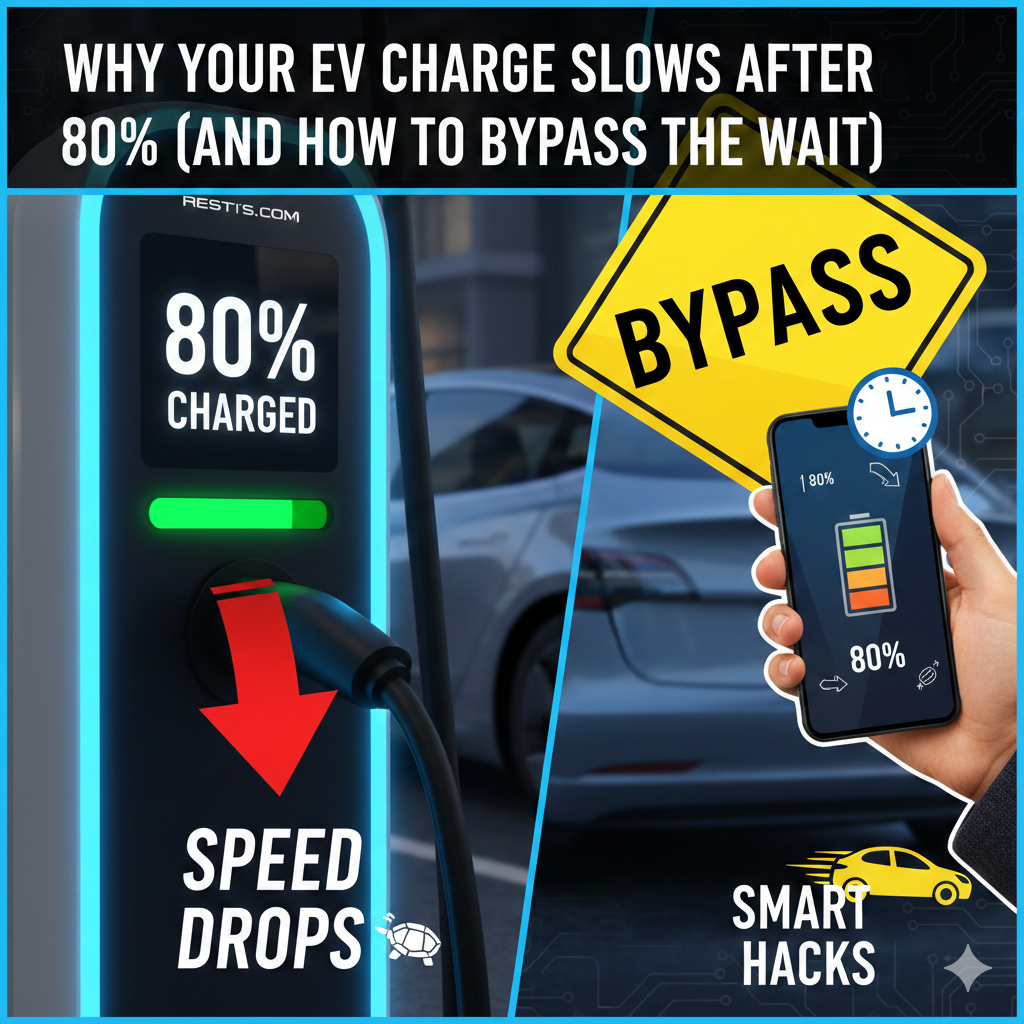
We have all been in this situation. You are on a road trip. You stop at a Tesla Supercharger or an Electrify America station. The screen says you are getting a fast charge of 150kW. You go get a cup of coffee and come back 15 minutes later. Then you see that your charging speed has gone down to 12kW.
You are, at 81 percent charged. You only have 50 miles to go.. The car says it will take 45 more minutes to finish charging.
You start to wonder what is going on. Is the charger not working right? Is your car battery getting old?
It is not any of those things. It is a safety feature that the car has. This feature is called the Charging Taper. In this guide we will tell you why the Charging Taper happens and we will give you some tips to get back on the road faster. We will talk about the Charging Taper. How it works.
The “Empty Stadium” Analogy: Why Physics Slows You Down
Imagine a place like Soldier Field.
When the doors first open and it is empty people can just go in. Sit wherever they want. They can move fast because there is a lot of space.
When the place is almost full, like eighty percent full the people in charge have to make everyone slow down. The new people who are coming in have to walk carefully and look for their seat and squeeze past other people to find a place to sit.
If people just kept running into a place that’s really crowded they would get hurt. In your car battery getting hurt means it gets too hot. That can make it not work as well forever or it could even catch on fire. So the computer in your car tells the thing that puts power in the battery to not give it much power. This is like telling people to slow down so they do not get hurt. The car battery is like the place and the power is, like the people running in. The computer has to make sure the car battery does not get much power when it is almost full or it could get hurt.
Can You Actually “Bypass” the 80% Limit?
Let us be honest: You cannot hack the software to force 150kW into a battery that’s 90 percent full. If you did that your battery would probably melt down.
However you can get around the frustration by changing your strategy. Here is how the professionals do it:
1. The “Deep SOC” Strategy
The best way to travel fast in the US is to get to a charging station when your cars battery’s low, like 10%. Then leave soon as its charged to 70% or 80%.
Here’s the math: it usually takes 20 minutes to charge from 10% to 70%.. Charging from 80% to 100% can take another 40 minutes.
The trick is: don’t wait. Just unplug when its, at 80% and drive to the charging station. You’ll save 20 minutes of sitting there.
2. The “Pre-Conditioning” Hack
If you drive in a place like the Midwest and Northeast your electric car battery gets too cold to charge quickly.
The Fix: Always enter your charging destination into the cars GPS. This helps the car warm up the battery so it’s ready to go when you plug in. A warm battery can charge faster for a time.
Why do some EVs charge faster when the battery is low, and how can I use this to my advantage?
When an EV battery is at a low state of charge (e.g., 20%), it can safely accept high levels of current. Essentially, the charger can “push” electricity into the battery quickly. Also, batteries produce more heat when they are nearly full, so the charging rate slows down to avoid overhearing your EV battery.
The charging curve goes something like this:
- 0–20%: Very fast charging
- 20–60%: Still pretty fast
- 60–80%: Slowing down
- 80–100%: Much slower
You can use this to your advantage by not charging more than you need to, and also by understanding that on a road trip, you’ll often get to your destination faster by charging your battery to a lower state of charge (which is quick) and then charging more often.
Here’s a day’s drive from Colorado, where I live, to Lawrence, KS, optimized for the fastest route. You’ll notice I am never charging above 55% (except when I start off from home) and the charging stops are 7, 13, 10, and 14 minutes.
Why do we need both fast and slow EV chargers, and what’s the real difference in cost?
Well, cost is one thing, and where it’s located is another. If your home only has a 120vAC outlet to charge from, then a Level 1 charge cord is all you need. BUT, it takes a loooong time to charge from 10–20% to 100% on Level 1 (often up to 5 or more days at 12 amps), so it’s only really suitable for people that don’t drive over about 30 miles a day normally, as you can replace that much range overnight while you sleep (basically never letting it get below about 80% charge. Slow charging like this doesn’t hurt the battery at all, so topping it off every night is perfectly fine for it. And generally it’s “free” as you don’t need to install a dedicated EVSE (wall box) as your car will come with a simple 120v plug/cord with it when you buy it.
Level 2 charging (240vAC) is the next step up. Perfect for homeowners that have a double pole 240v breaker spot in their main panel (basically like a dryer outlet). It’s also what most free public chargers are, as well as the ones starting to be installed at apartments and condos everywhere these days. Since most modern EVs come with dual level charge cords (both 120v and 240v plugs at the end) you still don’t have to have a dedicated EVSE to charge your car. Just a high quality NEMA 14–50 outlet:
Inside or out, it doesn’t matter (no need, ever, for a garage to charge in).
These chargers can go from empty to 100% charge in a matter of hours (4–5 hours for most EVs) so you CAN come home empty after a day of driving 300 miles and still get fully charged well before you need the car in the morning.
The last category is DC fast chargers (DC power, as opposed to AC power). These are high voltage, high wattage chargers designed to allow travelers to charge from 20%-80% in 15–20 minutes, and be on their way. Traveling is a real pain if you’re limited to Level 1 or Level 2 charging on the road (no one wants to stop for 4+ hours every 200–300 miles on a road trip. It’d be insane). Charging on these, however can shorten the battery life a bit (not as much as detractors say, but still…) so you don’t want to do it often. And really, at a public DC station, you don’t want to charge over 80% anyways. After 80% the charge speed slows down considerably, and it can take longer to go from 80–100% than it did to go from 20–80%. It’s considered rude to stay there after reaching 80% UNLESS you’re going to be traveling across a location that has no chargers within 80% range (and there’s getting fewer and fewer locations like that).
So that’s the reason for the different levels of chargers. Level 1 and 2 (AC outlets or stations) are perfect for home, work, restaurants, shopping centers, street parking, etc. They are cheap and fast enough for most people to use in their daily lives. DC Fast Chargers are really only for road trips, to get you in and out fast, though the cost of the stations is huge (and why it often costs 50 or more cents per kWh to charge at them).