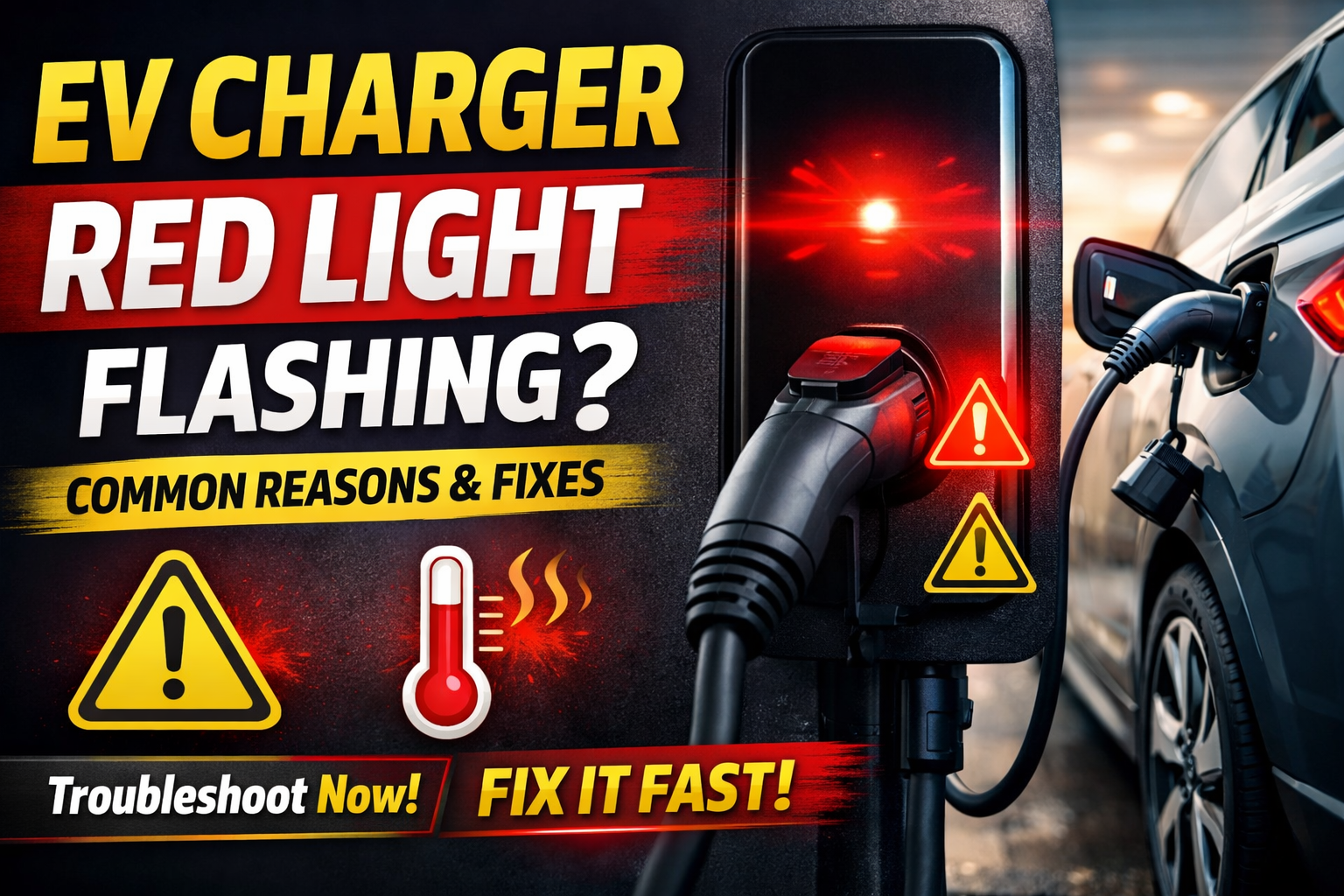
If your electric vehicle charger has a light that is flashing or stays on do not worry. Many people who own vehicles see this especially when they charge at home. Usually a red light does not mean that the charger is broken. It is a warning to keep your vehicle, charger and electrical system safe.
In this guide you will learn:
Simple steps to troubleshoot that you can try at home with your electric vehicle charger
What does a red light that flashes on an electric vehicle charger mean
The common reasons, for this
What Does a Red Light on an EV Charger Mean?
When you see a light on an Electric Vehicle charger it usually means something is wrong. This red light can be telling you that there is a problem with the power, the grounding the charger is getting too hot or the Electric Vehicle and the charger are not talking to each right.
Always remember: the red light, on the Electric Vehicle charger is there to protect you it is not something that is broken.
Common Reasons Why Your EV Charger Red Light is Flashing
- Power Supply or Voltage Problems
This is the common reason for Electric Vehicle charger errors.
- Voltage is too high or too low
- missing earthing
- Phase imbalance in three-Phase Electric Vehicle chargers
Electric Vehicle chargers are sensitive to power. If unsafe voltage or grounding is defective Electric Vehicle Charging stops automatically. The red light turns on.
- Electric Vehicle Charger Overheating
Overheating is another cause.
- Electric Vehicle Charger installed in sunlight
- Blocked ventilation
- ambient temperature
When the Electric Vehicle charger temperature rises beyond safe limits it pauses Electric Vehicle charging and shows a flashing red light to prevent damage.
- Charging Cable or Connector Issue
Sometimes the problem is simple but easy to miss.
- Electric Vehicle Charging gun not inserted properly
- Cable damaged from bending or wear
- Dust or moisture on Electric Vehicle charger connector pins
Always inspect the Electric Vehicle charging cable length, not just the ends.
- Communication Error Between Electric Vehicle and Charger
The Electric Vehicle and Electric Vehicle charger communicate continuously during Electric Vehicle charging.
- Temporary software glitch
- Electric Vehicle not responding correctly
In cases restarting the Electric Vehicle and Electric Vehicle charger fixes the issue. If the problem repeats a service check is recommended.
- Ground Fault or Leakage Current Detected
Modern Electric Vehicle chargers have built-in safety sensors.
- Poor earthing triggers a ground fault
- Leakage current detected as a safety risk
When this happens the Electric Vehicle charger immediately stops Electric Vehicle charging to avoid shock or system damage.
- Internal Electric Vehicle Charger Fault
If none of the issues apply the fault may be internal.
- Wiring issue
- Sensor or control board failure
In this case do not open the Electric Vehicle charger yourself. Contact the Electric Vehicle service center.
Quick Troubleshooting Steps You Can Try at Home
Before calling Electric Vehicle customer support try these steps:
- Turn off the Electric Vehicle charger
- Wait for 60 seconds
- Turn it back on
- Unplug and replug the Electric Vehicle charging gun properly
- Check if the circuit breaker has tripped
- Ensure there is no water or heat around the Electric Vehicle charger
Many minor Electric Vehicle charger issues get resolved with these steps. Understanding Electric Vehicle Charger Red Blink Patterns
Different Electric Vehicle charger brands use warning signals:
- Slow red blinking
- Fast red blinking
- Red light with beeping sound
Each pattern has a specific meaning, for the Electric Vehicle charger.
EV Charger Red Light Staying On (Not Blinking)
If the red light on your EV charger stays on it usually means:
- There is a voltage problem
- There is a grounding issue
- There is dust or moisture in the charging socket
- There are electrical connections
You can try cleaning the charging gun and socket carefully to fix the issue right away.
What to Do If EV Charger Red Light Stays On
Here are the steps to follow:
- Switch off the power supply.
- Wait for one, to two minutes.
- Switch it on.
4.. Reconnect the charger.
- Make sure the socket and plug are completely dry.
If the red light is still on stop using the charger and contact service support.
Is It Safe to Charge an EV When the Red Light Is On?
No it is not safe.
If the red light is flashing or stays on you should not charge your EV. The charger has detected a safety issue. Ignoring it may damage your EV or charger.
How do electric vehicles have such a range with so small of a battery?
My Volt uses about 20 kW at highway speeds. The Bolt, being newer and lighter may have better performance. Certainly a Tesla would; they have extremely good drag coefficients.
Also, highway driving is the worst situation for EVs; they are much more economical at city driving. This is because the slow speeds greatly reduce air resistance while stop and go driving, the bane of ICE vehicles, is less of a problem for EVs due to regenerative braking.
On average, I get close to 7 km per kWH in my Volt. My wife gets 7.5 in her Leaf. If the Bolt gets 7, they only need 54 kWh to go about 380 km, or 238 miles.
The reserve is generally unused. By that I mean they advertise a 60kWh battery, but they probably only allow it to drain 55 or so. This extends battery life. For comparison, my Volt uses 15 kWH of a battery rated at 19kWH and our Leaf uses about 22 out of 24.
Why don’t electric vehicles use gearing to extend range?
It doesn’t work like that. The taller the gear, the more energy it takes to turn it. Using what is presumably your premise, the motor would be working at a mechanical disadvantage, meaning it would require more energy to do the same work.
In that respect, they are geared for optimal range already. Maybe they should gear the motor that drives the ac compressor so that it takes less torque to turn. But if I thought of that surely the geniuses that design the ac systems have thought of it as well. So that optimization has probably already been done.
Still if I want more range I can drive without the AC, it makes a big difference. But to be honest, my model y has better range than my motorcycle and equal range as my lotus. So I’m not exactly worried about it too much. It really hasn’t been a problem.
Even my Hyundai Ioniq 5 which has significantly less range than the tesla hasn’t been a problem.
The biggest issue I’ve had is that at times when the ioniq 5 navigator says there is a charger at a certain location, it sometimes isn’t there at all. It would be comforting if they fixed that.