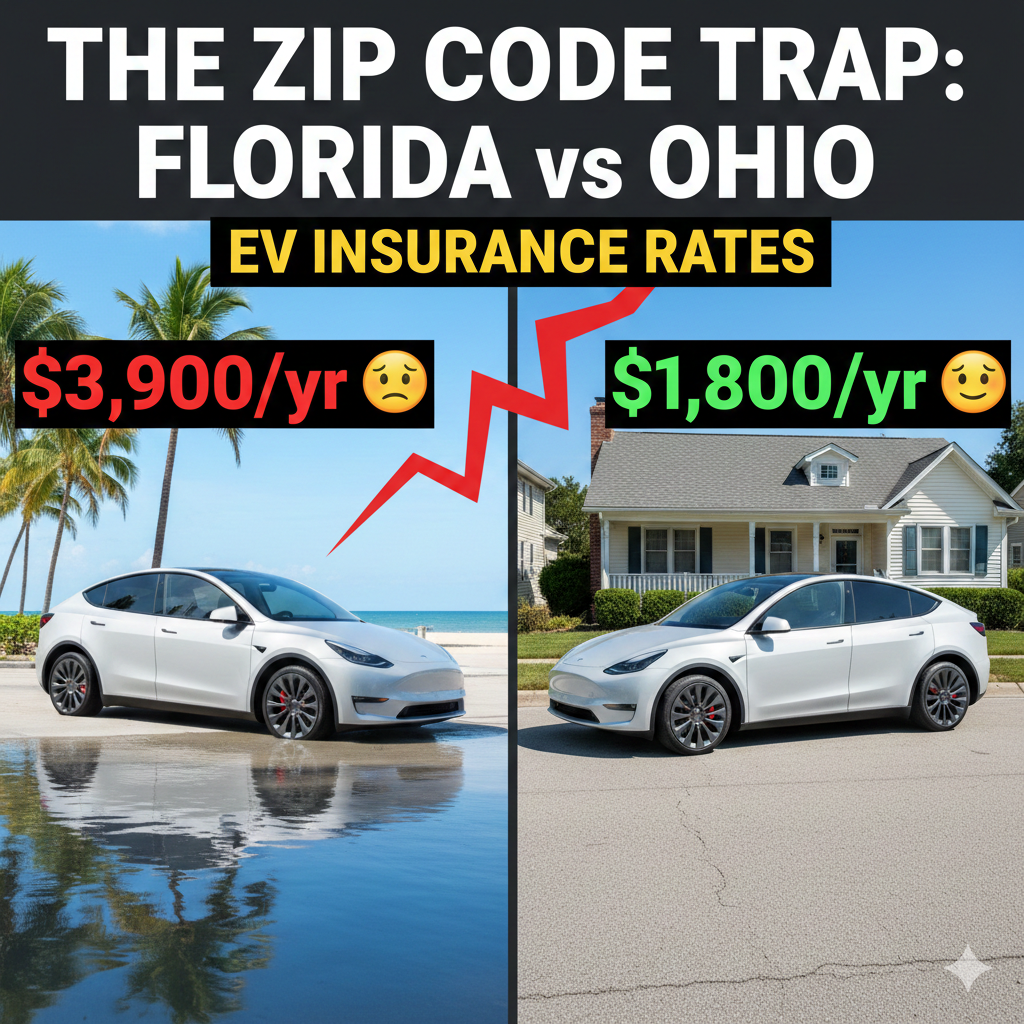
You got rid of your old gas-guzzler and bought a new Tesla or a really fast Rivian. You are feeling good about saving one hundred and fifty dollars a month on gas. Until you get your insurance bill in Miami.
If you are moving from a state like Ohio to Florida that money you saved from being green can disappear quickly. In the year two thousand and twenty-six the numbers are clear: people in Florida who own vehicles are paying a lot more for insurance, which is like a Sunshine Tax. This tax is forty percent to one hundred and ten percent higher than what people in the Midwest pay.
Let us talk about why your zip code matters than your driving record when it comes to the cost of insurance for electric vehicles, like your Tesla or Rivian.
The Reality Check: 2026 Price Comparison
I’ve seen dozens of drivers make this move. Here is what the actual annual hit looks like for a standard Tesla Model Y (the most insured EV in the US):
| Location | Annual Premium (Avg) | The “Hidden” Monthly Cost |
| Columbus, OH (Zip 43215) | $1,850 | $154 |
| Miami, FL (Zip 33101) | $3,950 | $329 |
| The Gap | +$2,100 | Equivalent to a car payment! |
Why Florida is an “Insurance Nightmare” for EVs
It is easy to blame the insurance companies. The reason why electric vehicle insurance is expensive is a mix of bad luck, bad weather and bad laws.
- The Flood Factor is a problem for electric vehicles.
In Ohio a heavy rainstorm might just mean a car wash. In Florida it is a loss.
If salt water from a storm surge touches an electric vehicle battery pack the car is effectively useless. Unlike a gas engine that can sometimes be rebuilt an electric vehicle battery replacement is so expensive that insurance companies simply declare the car a total loss. Since Florida has flood claims than almost any other state you pay for that risk every month when you own an electric vehicle.
- Florida is known as the Lawsuit Capital of the World.
Florida is a No-Fault state, which sounds good on paper but is a disaster for your wallet when you own a vehicle.
The scam is that Florida is famous for staged accidents and high-stakes litigation. Because of the states Personal Injury Protection laws, lawyers and medical clinics often inflate costs. Since electric vehicles are already expensive they are targets for these high-value lawsuits.
- The truth about uninsured drivers is shocking.
Imagine doing everything having a 100 percent clean driving record and then getting hit by someone with no insurance. In Florida 20 percent of drivers are uninsured. In Ohio that number is significantly lower. Because electric vehicles are made of aluminum and high-tech sensors, even a small accident from a driver can cost 10,000 dollars to fix. Your insurance company knows this so they hike your rates to cover the guys mistakes when you own an electric vehicle.
The Ohio Edge is why it is so cheap to insure a vehicle in Ohio.
Ohio is the state for insurance. The weather is predictable the state has a Tort system. There is massive competition between local insurance carriers. In Ohio your electric vehicle is treated like a car. In Florida it is treated like a liability.
A real person, Mark saved 170 dollars per month by moving
Mark lived in Fort Lauderdale. Paid 340 dollars per month for his Ford F-150 Lightning. When his job went remote he moved to Cleveland. Without changing his car, his driving habits or his coverage limits his bill dropped to 145 dollars per month.
He said it felt like he got a raise just by changing his mailing address.
Here are three insider tips to hack your rate in Florida.
Look for low-mileage discounts. If you work from home tell your insurer. If you drive under 5,000 miles a year you could save 20 percent.
The garage factor is also important. If you can prove your electric vehicle is parked in a secured raised garage away from flood zones some premium carriers like Chubb or Cincinnati Insurance might give you a break.
Tesla Insurance is the wildcard. If you drive a Tesla their in-house insurance is often the way to get Ohio prices in Florida but only if you have a Safety Score of 95 or more.
For EV owners, how much of an increase in insurance did you see? Including that, is it still more cost effective to own an EV?
I don’t have an EV at the moment but I can answer this as I recently got price quotes comparing different versions of the same vehicle.
Ford F-150 w/ 3.5 ecoboost gas : $0 Increase annually (same as I’m paying now)
Ford F-150 w/ 5.0 v8 gas: $22 increase annually from what I’m paying now
Ford F-150 w/ Powerboost Hybrid: $180 increase annually from what I’m paying now
Ford F-150 Lightning EV: $600 increase annually from what I’m paying now.
Leave any follow-up questions down in the comments below and I will do my best to answer them.
Why is it more expensive to put insurance on an EV car?
Evidence?
From what I’ve seen, insuring an EV costs less than insuring a gas vehicle of equal value. I mean, you can cheat with statistics if you like. For example this article on Forbes claims it costs more by comparing the electric version of cars to their gas version.
Well doh, spend more on a car and the insurance will be higher. What’s next? Spend more on a car and you’ll get bigger premiums? I found a different article which compared the cost to insure a brand new Tesla to the average American car. Hopefully you can see what’s wrong with the statistics there too. (Deliberately not linking because I think the author gets paid per click).
The two things that determine a car’s insurance are accident rates and repair costs. EVs are slightly less likely to have an accident which pushes down the insurance, and the repair costs are somewhat higher which pushes it up. Both end up averaging out in most cases so the final cost is very close.
Asked Questions are answered below.
Why is electric vehicle insurance more expensive than gas cars?
It is the Repairability Index. A fender bender on a Honda Civic is 800 dollars. The same hit on a Rivian could require replacing the rear quarter panel and recalibrating 3,000 dollars worth of sensors.
Does Floridas sunshine help my electric vehicle battery?
Actually extreme heat can degrade lithium-ion batteries over a period but it is the humidity and salt air that concern insurers more due to potential corrosion, on electrical components.
Is it cheaper to insure a used vehicle?
Not necessarily. While the cars value is lower the cost of parts and labor remains the same. A 5-year-old Tesla costs as much to fix as a brand-new one.
Will rates go down?
There is hope. Floridas legislature is currently debating reforms to limit lawsuits. If these pass we could see a 10-15 percent dip by 2026.