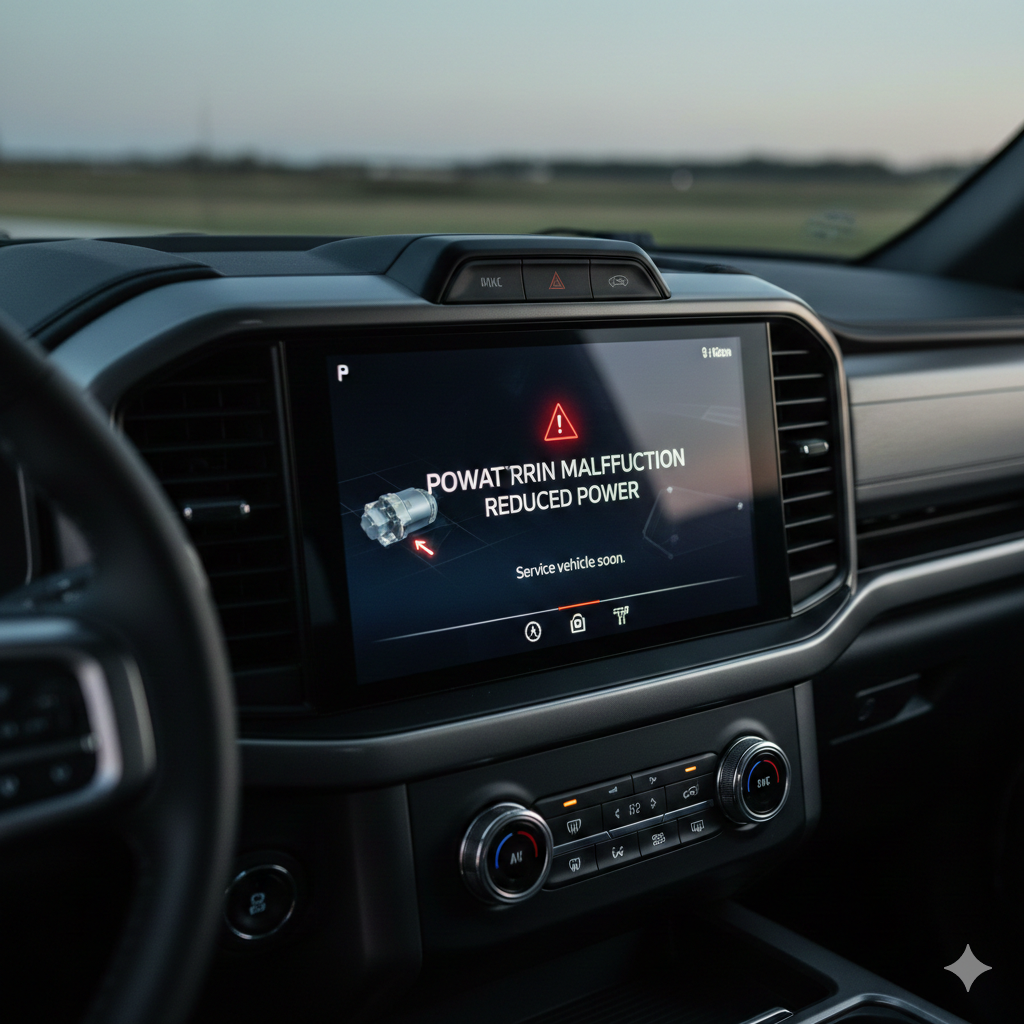
Ford F-150 Lightning Service Vehicle Soon Light: Common Causes and Fixes
Owning a 2025 Ford F-150 Lightning is like getting a glimpse of what the future of trucks will be.. Even the most advanced trucks can have technical problems. Lately a lot of 2025 Ford F-150 Lightning owners those with the Flash trim have been seeing a “Service Vehicle Soon” light on their dashboard. They also get a “Powertrain Malfunction / Reduced Power” warning on the FordPass app.
If you see a wrench icon on your dashboard and your 2025 Ford F-150 Lightning does not feel right you are not alone. Lets break down what might be causing the problem and how a simple part inside your truck could be the reason.
The symptoms are not a warning light. For 2025 Ford F-150 Lightning owners the problem starts with warnings that come and go.
- The wrench icon appears on the dashboard with a “Service Vehicle message.
- The FordPass app sends notifications that say “Powertrain Malfunction / Reduced Power.”
- The light may stay on for a times you start the truck then go away for weeks and come back without warning.
The “Reduced Power” message sounds scary. A lot of drivers say their 2025 Ford F-150 Lightning still drives normally which is confusing.
The surprising reason for the problem is the folding gear shifter. You might not think that a feature that makes your life easier would cause a warning about the powertrain.. The folding electronic shifter in the 2025 Ford F-150 Lightning is a complicated piece of equipment.
In cases the “Service Vehicle Soon” light is directly related to a problem with the Gear Shift Module. This is the part that lets the shifter fold flat into the center console to create a workspace.
To test your shifter do this:
- Park your 2025 Ford F-150 Lightning.
- Press the button that makes the shifter fold down.
If you hear a “click-click” sound but the shifter stays up the motor or module inside is probably broken.
Even if you do not use this feature often a problem with the communication between the shifter module and the trucks main computer can cause a fault code with the powertrain.
When you take your 2025 Ford F-150 Lightning to the dealer they will scan for trouble codes. A common code for this problem is P0929, which means there is a problem with the Gear Shift Lock Solenoid Control Circuit.
Ford has a fix for this problem, which is explained in Technical Service Bulletin 25-2276. The usual fix is to:
- Check the wiring for problems with the pins or corrosion.
- Replace the Gear Shift Module entirely.
Note that because this is a problem with newer 2025 Ford F-150 Lightning models the repair is usually covered 100 percent by the factory warranty. However you might have to wait for the part to arrive because it is in demand.
If you are taking your 2025 Ford F-150 Lightning to the dealership here are a things to keep in mind:
- The Gear Shift Module might be, on backorder so it could take one to two weeks to get the part and fix the truck.
- Make sure to talk to your service advisor and stay on top of things. If your truck is still drivable you might be able to keep using it while you wait for the part to arrive.
After the module is replaced the “Service Vehicle light should go away and the folding mechanism should work smoothly without making any clicking noises.
Ford F-150 Lightning Powertrain Malfunction: Why the OTA Fix Might Not Be Enough
The Ford F-150 Lightning is a deal in the electric pickup truck world but like anything new it has some problems. One thing that really bothers owners of the 2023 and 2024 Ford F-150 Lightning is the “Powertrain Malfunction / Reduced Power” error.
If you have seen the yellow wrench icon on your Ford F-150 Lightning dashboard you are not alone. A lot of Ford F-150 Lightning owners say that even after they take their Ford F-150 Lightning to the dealership and get Over-the-Air software updates, the error keeps happening.
The Ford F-150 Lightning has some symptoms that’re like the “Check Engine Light” on other cars. Since the Ford F-150 Lightning is a vehicle it uses the powertrain malfunction light to warn you of a problem. Some things that Ford F-150 Lightning owners notice are:
- A yellow wrench icon that stays on the Ford F-150 Lightning dashboard.
- Messages that say “Service Vehicle on the Ford F-150 Lightning.
- The FordPass App sends notifications about problems, with the four-wheel drive or the powertrain of the Ford F-150 Lightning.
- Sometimes the Ford F-150 Lightning goes into “Limp Mode” which means it does not have all its power, only about 70% or less but a lot of drivers say their Ford F-150 Lightning drives fine even with the warning.
Top 3 Real-World Causes (Based on Owner Data)
While Ford often tries to fix these problems with software updates many owners have found that the real issue is often with the hardware. Here are the common causes:
- The Shift Module Failure
Many 2023 models have been reported to have shift modules. This is a problem. When this module fails it sends a fault code to the computer, which triggers the powertrain warning.
The Fix: You need to replace the shift module. This often requires parts that are backordered from the dealer.
- Electronic Diverter Valve (Coolant Issue)
The Lightning has a cooling system to manage the battery temperature. A common problem is the gears inside the electronic diverter valve. If these gears wear out the truck can’t manage heat properly leading to a “Reduced Power” error.
- The 12V Battery Health
It may sound simple. A failing 12V battery can cause problems with the EVs sensors. If the 12V battery, which powers the trucks computers is weak it can trigger codes like steering failure or brake malfunctions that aren’t really happening.
The “OTA Update” Trap
Many people in the community are frustrated with the OTA (Over-the-Air) “Fix.” Dealers often clear the fault codes. Tell owners that a recent software update solved the problem.
However many users have documented that if there is a hardware problem in a module the software update only hides the issue for a time. If the hardware, like the valve or shift module is still faulty the error will likely come back within a few days or weeks.
What Should You Do?
If your Ford Lightning is throwing this error follow these steps to ensure a fix:
- Document the Power Gauge: Check your “Power Available” gauge. If it’s below 100% take a photo to prove to the dealer that the truck’s, in “Reduced Power” mode.
- Use an OBD-II Reader: While it won’t show everything some readers can identify if the fault is coming from a module.
- Mention Specific Components: Don’t just ask for a software update. Ask the technician to check the Shift Module and the Coolant Diverter Valve.
- Check Your 12V Battery: If you’re getting messages at startup have the dealer test the health of the 12V battery, not just the high-voltage pack.
What do you think of the Ford F-150 Lightning?
Here is how I see it. In my work, I travel long distances in the west. For example, I may have to drive from Helena, MT to Rapid City, SD to be onsite for a well drilling project the next day. In my F-150 Eco-Boost, taking the shortest route of 556 miles, it is about a 9-hour trip.
The EV Ford Lightning with the extended range package is rated by the EPA for 320 miles per charge. Articles about trying out the vehicle indicate that at an average speed of 75 mph (I travel about 80 mph on this route), the range is reduced to 256 miles per charge. The charge time with the 80A Ford Charge Station Pro for 15–100% is 8 hours. This means I have to plan my route just like flying a small airplane or I will run out of gas (figuratively speaking).
My first logical charge stop would be Billings, MT at 239 miles. Prorating the charge time by the mileage traveled, I would have a charge time of 7.47 hours. My next charge on this shortest route is a stretch as there is very little in the way of towns along this route. I might find a charger at Broadus, MT which is another 167 miles down the road, but a very rural and isolated community where the availability of a charging station is currently problematic. This means stretching my next leg of the trip to Belle Fourche, SD at 262 miles, slightly more distance than the de-rated 256-mile range of the truck at 75 mph. This would require an 8.19 hour charging time, assuming I make it to that location. I would have another 55 miles to go to Rapid City, giving me a total trip time of 24 hours as compared to 9 hours for my gas-powered F-150.
If I take a slightly longer route on the interstate highway, where charging stations are more likely to be available, I still will have a trip time of about 24 hours.
Since I travel for business, the labor factor and travel expenses for meals and lodging for driving an EV to jobs would run my costs to my client out of sight. Is this the future of how we will have to operate in this country???
So what do I think of the Ford F-150 Lightning? It is a technical marvel until the battery goes dead. Who doesn’t like more than 500 horsepower and more than 700 foot pounds of torque? However, it is not a very practical vehicle for folks with my transportation requirements. I did similar calculations for driving from Boise, ID to Phoenix, AZ and found that the estimated travel time for the EV, including charging time, is 27 hours as compared to 14 hours for my gas-powered F-150. And that is assuming I can find charging stations along the low population route through Nevada and not have to take the longer route through Salt Lake City.
Without some very large advances in technology, these EVs are not practical for long-distance travel in the western US and I cannot imagine how the current technology can be practical for long-distance truck transportation of food and consumer goods. How about a farmer in central Montana farming 10,000 to 20,000 acres with a large tractor? Will he have to drive back to a power source every day??? Will he have to pay for infrastructure to provide charging stations at enough locations he does not have to spend all his time driving a slow-moving tractor back to a charging station multiple times and then sit around waiting for it to charge while he gets further and further behind on his work? To add insult to injury, the EVs currently transfer use of fossil fuels in the vehicle to use at a fossil fuel power plant, so there really is not any present benefit to the environment, particularly when you consider the environmental impact of obtaining materials for the batteries, let alone the fact that the rare earth’s needed for the EVs are currently available only from foreign countries and the resource is largely controlled by China, i.e., the CCP. The notion that we can run all these EVs on wind and solar power is not sensible or sustainable without a source of base power. Currently, our base power is changing to natural gas, a fossil fuel, as we elect not to use neuclear energy as a matter of policy.
If EVs are to be practical for anything but local travel in an urban area, technology has to solve the problem the long charge time poses and there needs to be a long-term plan for an orderly establishment of infrastructure to use these things. I read things like the EPA rated 320-mile range becomes about 100 miles if you are towing a heavy load. I cannot find any data about how the batteries and travel range are degraded by cold weather, but that is a major consideration where I live. Moreover, I know my gas-powered car will keep me warm if I get stranded in winter weather. How long will an EV keep me warm before the batteries die? There is no equivalent in an EV to the extra fuel I can carry for my F-150 during the winter when I am on long trips on lightly traveled routes.
All in all, EVs are a neat idea, but there are a lot of issues that should be resolved or at least planned for future resolution before we force everyone into EVs willy nilly with no consideration of the consequences.